


CodeScout
Collection
RL-trained code search agents (1.7B, 4B, 14B) that outperform 2–18× larger models using only a Unix terminal. 📄 arxiv.org/abs/2603.17829 • 12 items • Updated
📄 Paper • 💻 Code • 🤗 Collection
Best efficiency–performance trade-off — outperforms 8× larger Qwen3-32B across all benchmarks.
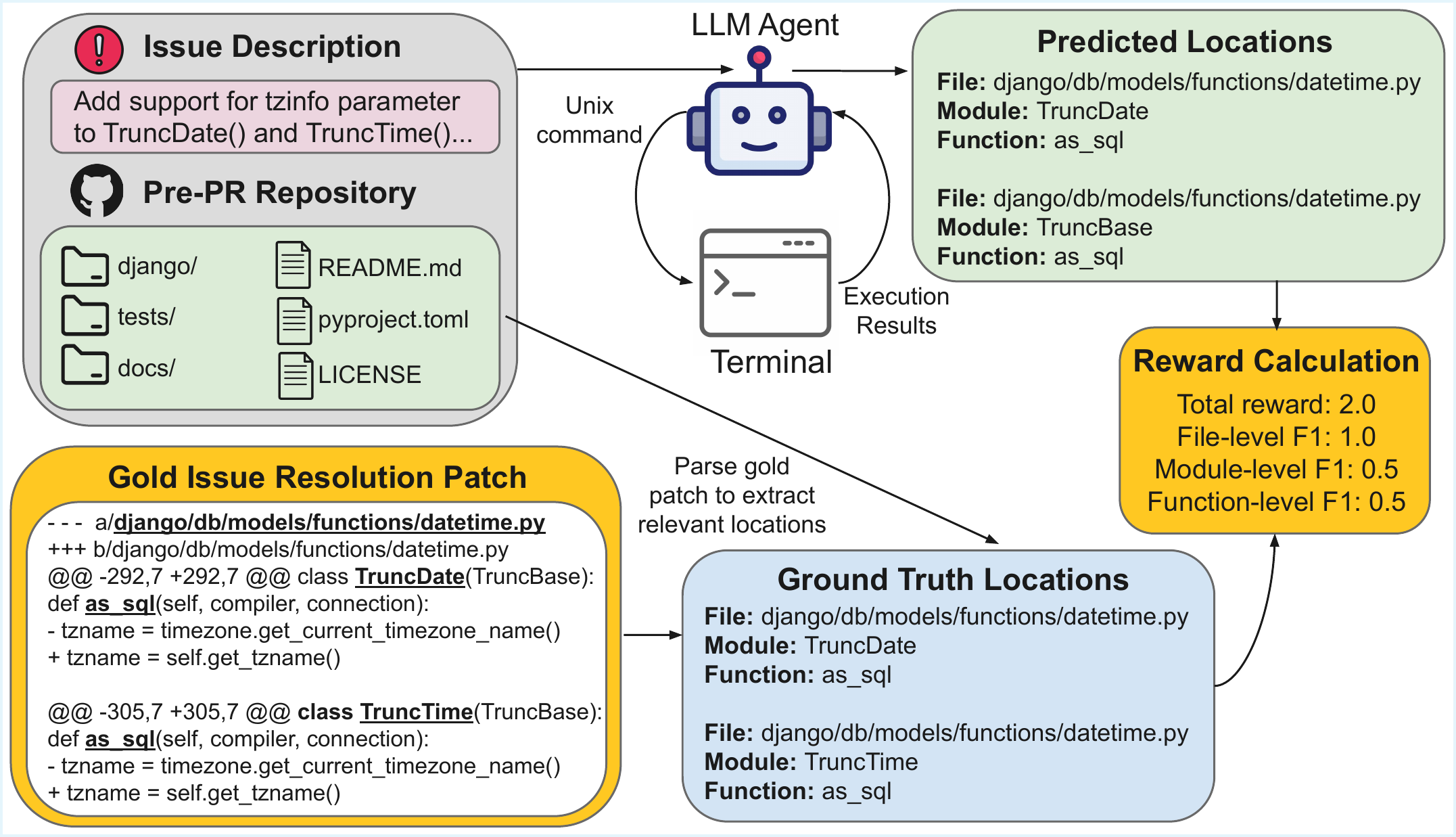
CodeScout-4B is part of the CodeScout family of open-source RL-trained code search agents. CodeScout models achieve state-of-the-art repository-level code localization using nothing more than a standard Unix terminal — no static analysis, no repository graphs, no language-specific tooling.
Performance on SWE-Bench code localization (instance-averaged F1 scores):
| Benchmark | CodeScout-1.7B | CodeScout-4B | CodeScout-14B |
|---|---|---|---|
| SWE-Bench Verified — File F1 | 55.46 | 68.52 | 68.57 |
| SWE-Bench Verified — Func F1 | 28.22 | 36.78 | 40.32 |
| SWE-Bench Pro — File F1 | 40.96 | 51.77 | 53.63 |
| SWE-Bench Pro — Func F1 | 18.24 | 29.03 | 28.74 |
| SWE-Bench Lite — File F1 | 56.57 | 67.03 | 71.84 |
| SWE-Bench Lite — Func F1 | 27.07 | 39.87 | 44.43 |
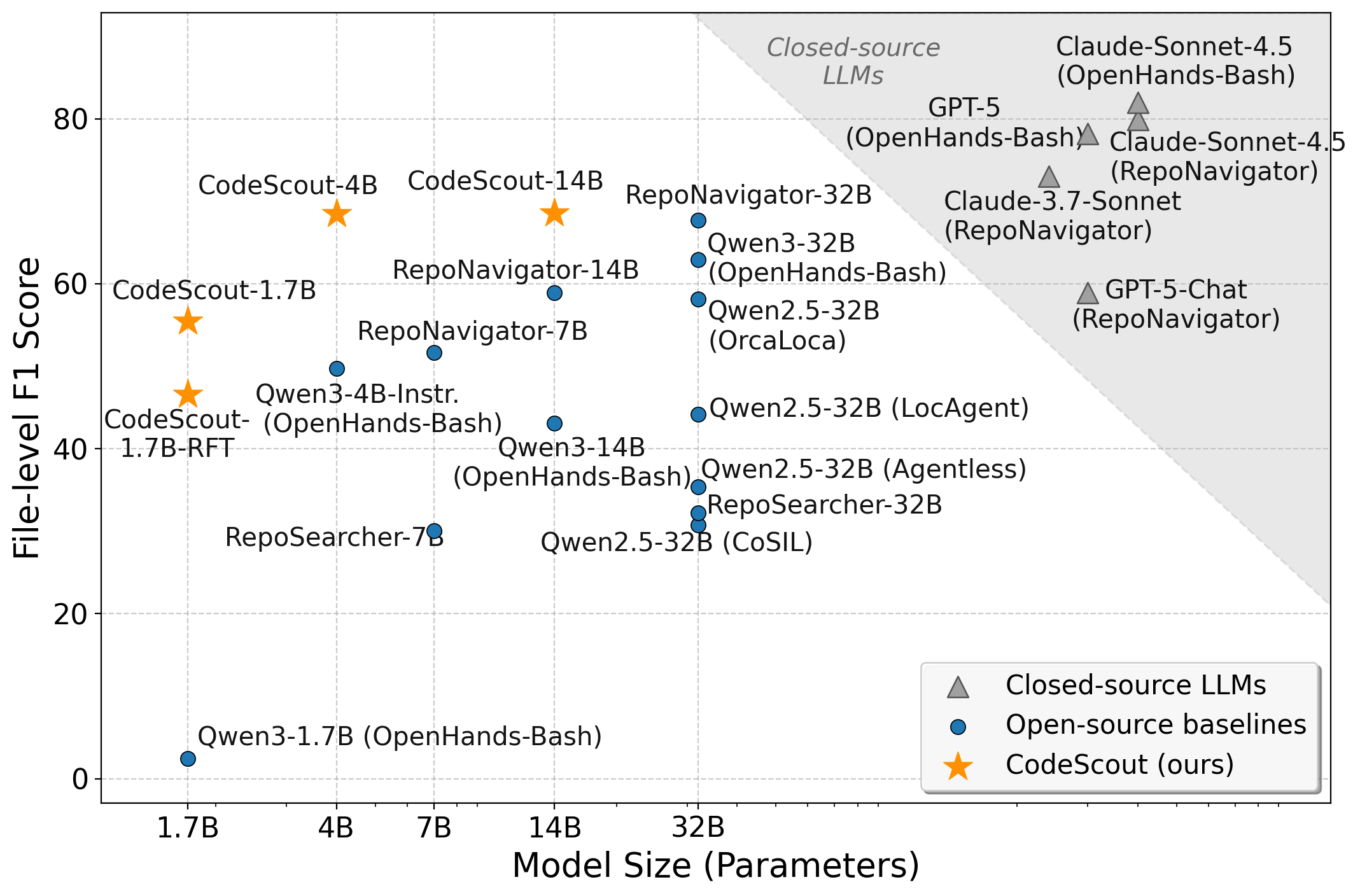
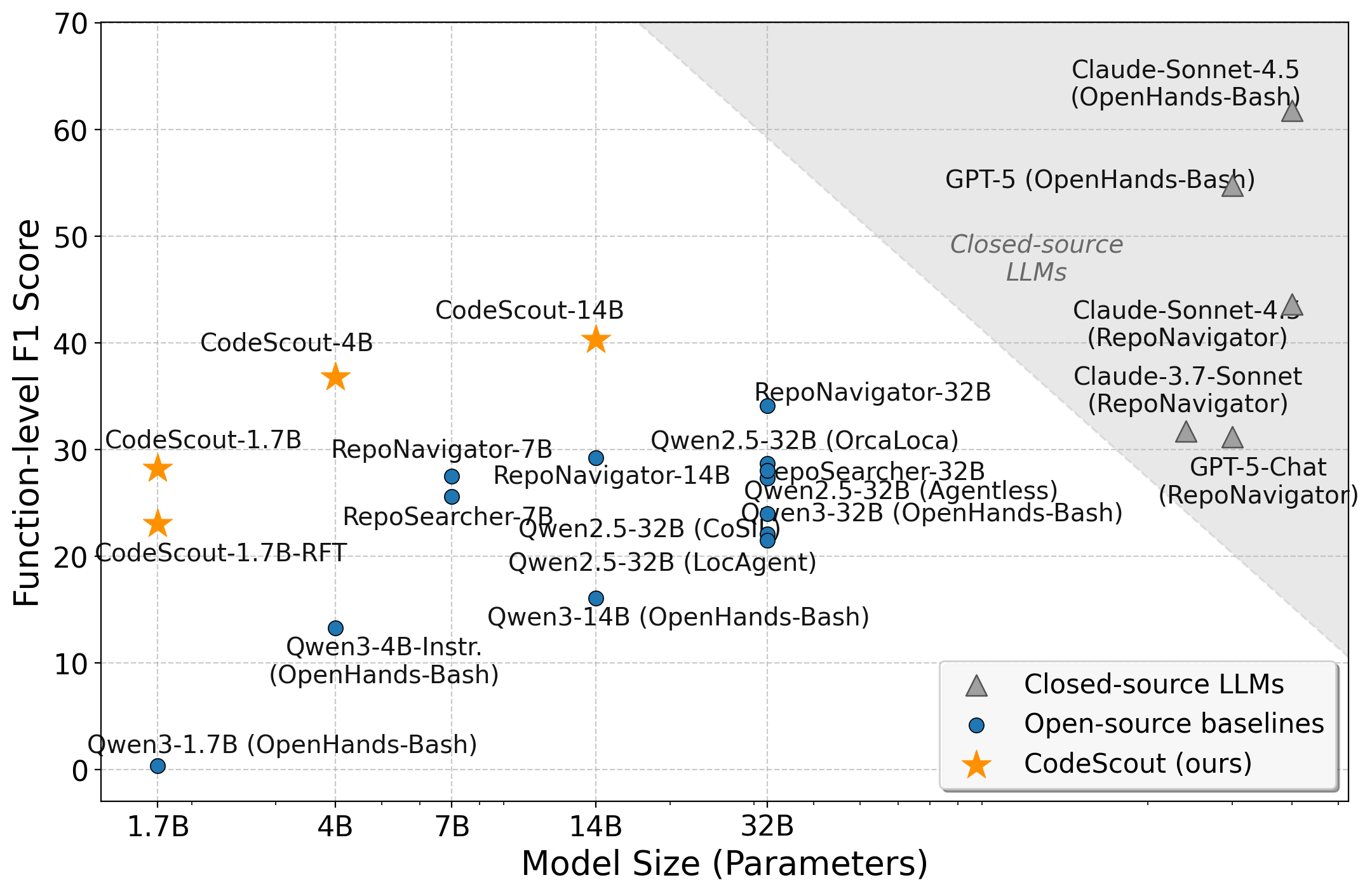
Code localization performance on SWE-Bench Verified. CodeScout (⭐) achieves superior or competitive results over larger open-source LLMs and narrows the gap with closed-source frontier models.
CodeScout-4B is trained directly from Qwen3-4B-Instruct-2507 using GSPO reinforcement learning.
CodeScout uses the OpenHands-Bash scaffold — an agent equipped with only a Terminal tool (supporting standard Unix commands like rg, find, grep, ls) and a LocalizationFinish tool for structured output submission. The agent iteratively navigates the repository to identify relevant files, classes, and functions related to a given issue.
The model is trained with GSPO (Group Sequence Policy Optimization) using multi-level F1 rewards at the file, module, and function level.
CodeScout-4B is designed for repository-level code localization: given a GitHub issue description and a code repository, it identifies the relevant files, classes, and functions that need to be modified. It is intended to be used as a localization subagent within larger coding agent pipelines.
@misc{sutawika2026codescouteffectiverecipereinforcement,
      title={CodeScout: An Effective Recipe for Reinforcement Learning of Code Search Agents},
      author={Lintang Sutawika and Aditya Bharat Soni and Bharath Sriraam R R and Apurva Gandhi and Taha Yassine and Sanidhya Vijayvargiya and Yuchen Li and Xuhui Zhou and Yilin Zhang and Leander Melroy Maben and Graham Neubig},
      year={2026},
      eprint={2603.17829},
      archivePrefix={arXiv},
      primaryClass={cs.SE},
      url={https://arxiv.org/abs/2603.17829},
}
Base model
Qwen/Qwen3-4B-Instruct-2507